
HUGH MAGNUS
CATALOGUE ESSAY FOR KATE TUCKER’S Fragment, Unknown
mingled with all kinds of colours
Sappho, Fragment 152
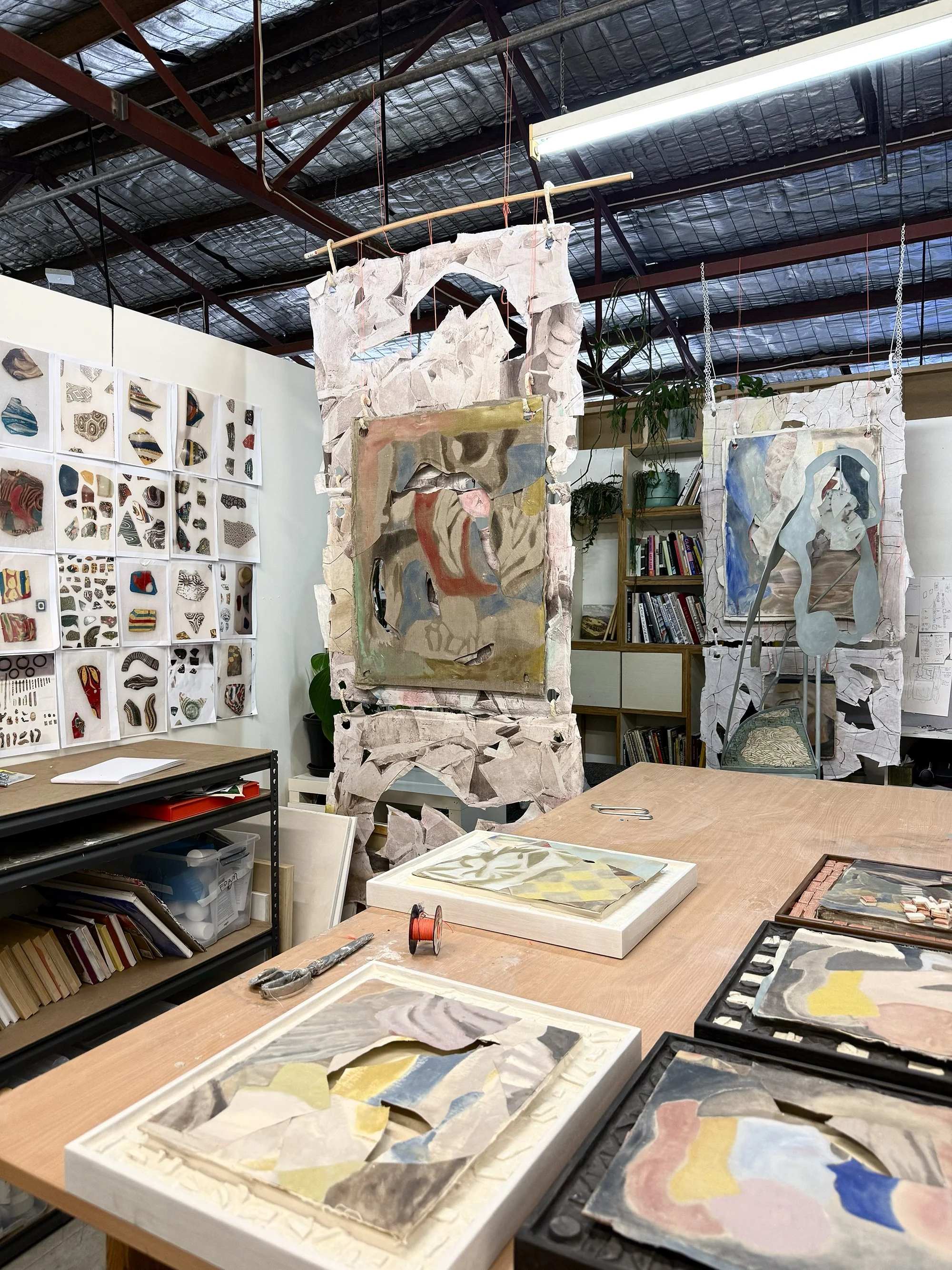
Hundreds of shards illustrate the back wall of Kate Tucker’s studio, printed images of glass and ceramic illuminating the room in a mosaic of glimmering colours and textures. More sit in a sheaf on the bench below. Each image shows a jumble of hues, shapes, sizes, ages: bits of Attic vases, chips of Murano millefiori, splinters of faience and celadon ware, many more beyond identification. The images come from the Victoria and Albert Museum in London, where seemingly endless trays of fragments like these sit in storage. These fragments are unknown objects, divorced from their historical and cultural contexts. And yet in their numbers, read together with others from innumerable times and places, they tell a story of the human quest for beauty, of developing tastes and craftsmanship over thousands of years. Every piece here has been made by a talented craftsman, someone with the practiced skill and steady hands to fashion objects of brilliant and enduring charm.
The word ‘fragment’ comes from the Latin frangere, which in turn shares a common ancestor to our word ‘break’. Frangere also gives us ‘fracture’ and ‘fragile’. Verb and noun, cause and effect united together on one family tree. All of these are useful words in beginning to consider Kate Tucker’s practice. Many of the works in this show have undergone a process of fragmentation and reunification, mosaics on canvas or in clay painstakingly sliced up, rearranged, patched back together. There are echoes of this practice in each of these works, from the drawings in clay scanned and digitally printed on large, hanging paintings, to the quilted, beautifully patinated effect of the handmade tiles that appear regularly throughout this exhibition. While the heavy concrete and solid frames of some of the works in Fragment, Unknown make them appear anything but fragile, their pairing with the delicate colours and rangy supports of others gives rise to delightful yet unexpected conversations between mediums and works.
Like Tucker’s V&A shards, the work of the Greek poet Sappho has largely only been preserved in fragments. We have inherited mere half-glimpses, questions, solitary words that seem to glow in their mysterious import. For Anne Carson, the edges of these fragmented texts are their most exciting aspect. Where papyrus has torn, obscuring half a sentence, where a blot on the page renders words illegible; the edge of a textual fragment becomes ‘a free space of imaginal adventure’, where we are free to make connections, associations, assumptions and propositions without the constraints of a supporting context.(1)
The same could be said for Kate Tucker’s work. Our own ‘imaginal adventure’ begins with the works’ borders, liminal zones demarcated by braided linen, ceramic, steel or welded supports. But these are not the true edge. In blurring the boundaries of her mediums, Tucker extracts the centre of a work and pushes it towards the margins, bringing the real edges—the disjointed spaces between cut linen, the lines of grout surrounding a glazed tile, the void created by layered canvas—towards the heart of the work.
This preoccupation with the fragmented image shares much in common with Georg Baselitz’s Frakturbilder (‘fracture pictures’) of the late 1960s, in which the artist began to paint figures on a divided canvas, each segment of the body independently formed yet still interrelated. Tucker’s practice takes this idea one step further, intuitively cutting paintings into pieces and later reassembling them in new configurations, developing relationships not only between the different painted components of the work, but between all its various internal and external edges.
The dialogues that emerge from Tucker’s pairings of unexpected mediums similarly confound our ability to distinguish hard boundaries. The textural contrast between these unpolished supports and the sheen of oil paint or glaze is alluring, a playful flirtation between tactility and tone. Tucker’s ease in combining unorthodox materials confounds any preconception as to the strictures of medium. Just as we begin to read a work as a painting, we must turn course: the ceramic support pushes it towards sculpture. Similarly, reading a freestanding sculpture pushed up against the wall flattens its planes, reducing a tangled web of curves to a painterly composition of arching lines. The effect of this is a levelling: we are all in the same place before Tucker’s work, led simply by a dedication to ceaseless material experimentation and the precise hand of a master colourist. One does not have to be a connoisseur or a scholar to appreciate these paintings. Rather, what is most important here is the emotion and curiosity that the works stimulate within us, the time to take a second glimpse, the imaginal adventure of decoding the edge.
— Hugh Magnus, 2026
Anne Carson, If Not, Winter: Fragments of Sappho (London: Virago, 2002) p. xi